
AI Tutors by 2030: The Difference Between Getting an Answer and Understanding It
Anthropic's education research suggests AI will become an everyday academic companion. The harder question is whether future tutors will help students think—or simply finish the work for them.
The most useful question about AI and education is not whether students will use AI by 2030. They already are.
The better question is what they will ask AI to do.
Will it be a vending machine for finished answers? Or will it become a thinking partner that helps students build, test, and repair their understanding?
Anthropic's education research offers useful clues, but not a guaranteed forecast. Its report on how university students use Claude describes AI systems becoming everyday academic companions for problem-solving, writing, research, and learning. Its report on how educators use Claude shows a parallel change on the teaching side: educators use AI for preparation and other routine work, while questions about judgment, trust, and classroom responsibility remain human ones.
Taken together, these reports point to a plausible direction for 2030: AI will be part of ordinary learning, but access alone will not determine whether students learn well.
The answer is not the same as understanding
An AI can produce a clear explanation in seconds. That is useful, but clarity is not proof of comprehension.
A student can read an explanation of photosynthesis, nod at every sentence, and still be unable to explain what changes when light, water, or carbon dioxide becomes limited. The answer was present. The mental model was not necessarily built.
This is the difference between receiving a solution and constructing an explanation.
When a tool completes the difficult parts silently, it hides the places where the learner is confused. A polished response can therefore create an uncomfortable illusion: the material feels familiar because it was easy to read, even though the student has not retrieved, connected, or explained it independently.
That is why the important AI-education question is not simply, “Did the model answer correctly?” It is also:
“What did the learner have to think through?”
What AI may change for teachers
Anthropic's educator report cites a Gallup survey in which teachers reported saving an average of 5.9 hours per week with AI tools. That kind of time saving could matter enormously, especially when it is used to reduce repetitive preparation rather than remove human contact.
The optimistic version of this future looks like:
- AI helps prepare examples, drafts, and lesson materials.
- Teachers spend more time noticing misconceptions.
- Students receive more opportunities for individual feedback.
- Educators remain responsible for context, care, assessment, and judgment.
The less optimistic version is that institutions use efficiency as a reason to reduce the parts of education that require attention and relationships.
The technology cannot decide which future is chosen. Schools, universities, teachers, and students still have to decide what should remain human.
AI fluency will become a learning skill
By 2030, being “good with AI” will probably mean more than writing clever prompts. Students will need to know how to work with an answer without surrendering their judgment.
Useful AI fluency includes:
- Making a prediction before asking. A first attempt gives the learner something to compare with the model's response.
- Questioning the transition between steps. “Why does this follow?” is often more valuable than “What is the answer?”
- Checking evidence and assumptions. A confident explanation can still omit context or contain an error.
- Changing the representation. Ask for an example, a counterexample, a diagram, or a simpler explanation.
- Explaining the idea back without the tool. If the explanation disappears when the chat closes, the learning is not finished.
These habits turn AI from an answer machine into a structured form of practice.
The interface changes the learning behavior
Most chat tools make one workflow feel natural:
Question → Answer → Next question
That workflow is excellent when the goal is to retrieve information quickly. It is less reliable when the goal is to build a mental model with several connected parts.
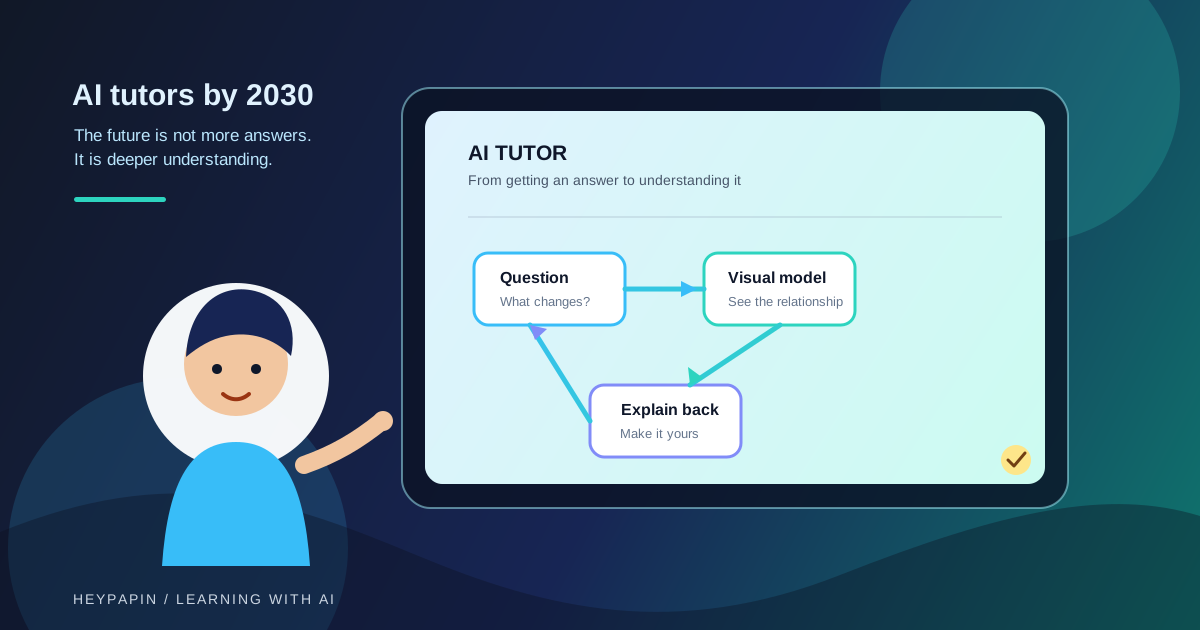
A shared visual workspace encourages a different loop:
Question → Visible concept → Follow-up question → Revised model → Explain it back
The diagram is not decoration. It gives the learner something to point at, challenge, move, and connect. When a student interrupts an explanation to ask about one arrow or one missing relationship, the interruption reveals the exact location of confusion.
That is the promise of a learning interface built around a living board: the student does not have to wait until the end of a long answer to say, “I lost you here.”
What a 2030 AI tutor should do
A useful AI tutor should not always make the path shorter. Sometimes it should make the learner do the next small piece.
It should:
- Ask what the student already knows.
- Break difficult ideas into visible, testable steps.
- Leave room for prediction and retrieval.
- Let the student interrupt without losing context.
- Show how concepts relate, not only what each concept means.
- Offer a hint before revealing a complete solution.
- Check whether the student can use the idea in a new situation.
This does not mean AI tutors should become artificially difficult or refuse to help. It means help should be calibrated to the learner's goal. A student revising a known topic may need a concise answer. A student encountering a difficult concept for the first time may need a slower conversation with more opportunities to ask, point, and try.
Where HeyPapin fits
HeyPapin is built around that second kind of interaction. It explains while drawing, keeps the explanation connected to a shared board, and lets the learner interrupt when a step does not make sense.
The board is not intended to replace the learner's thinking. It is an external place where that thinking can become visible. A student can follow a relationship, ask about one part, and return to the larger structure without losing the thread.
That distinction matters. We do not think a visual explanation automatically teaches. A finished diagram can still be passive. The value comes from the conversation around it: the questions, corrections, predictions, and moments where the learner takes over.
The real 2030 prediction
Anthropic's economic scenarios research is a reminder that the future is not one fixed timeline. Different choices about adoption, institutions, policy, and access can produce very different outcomes.
The same is true in education. AI will not automatically create better learning just because it becomes more capable.
The decisive question will be whether our tools reward students for obtaining answers or help them become capable of producing explanations themselves.
The best AI tutor of 2030 will not necessarily be the one that answers fastest. It will be the one that helps a student understand enough to continue without it.
Sources
- Anthropic: How university students use Claude
- Anthropic: How educators use Claude
- Anthropic Institute: Scenarios for our Economic Future
#AIinEducation #Learning #AITutors #AIFluency