
From Devin to Grok Bot: The Explosion of AI Agents, and the Paradox of Human Learning
With Devin crossing a $1B ARR run rate and xAI deploying Grok 4.7's stamina-driven autonomous bots across enterprise pipelines, the era of conversational chatbots has ended. But as machines become capable of building entire software systems in silent, multi-hour loops, a new cognitive crisis has emerged: what happens to human engineers when AI can execute everything, but teaches nothing?
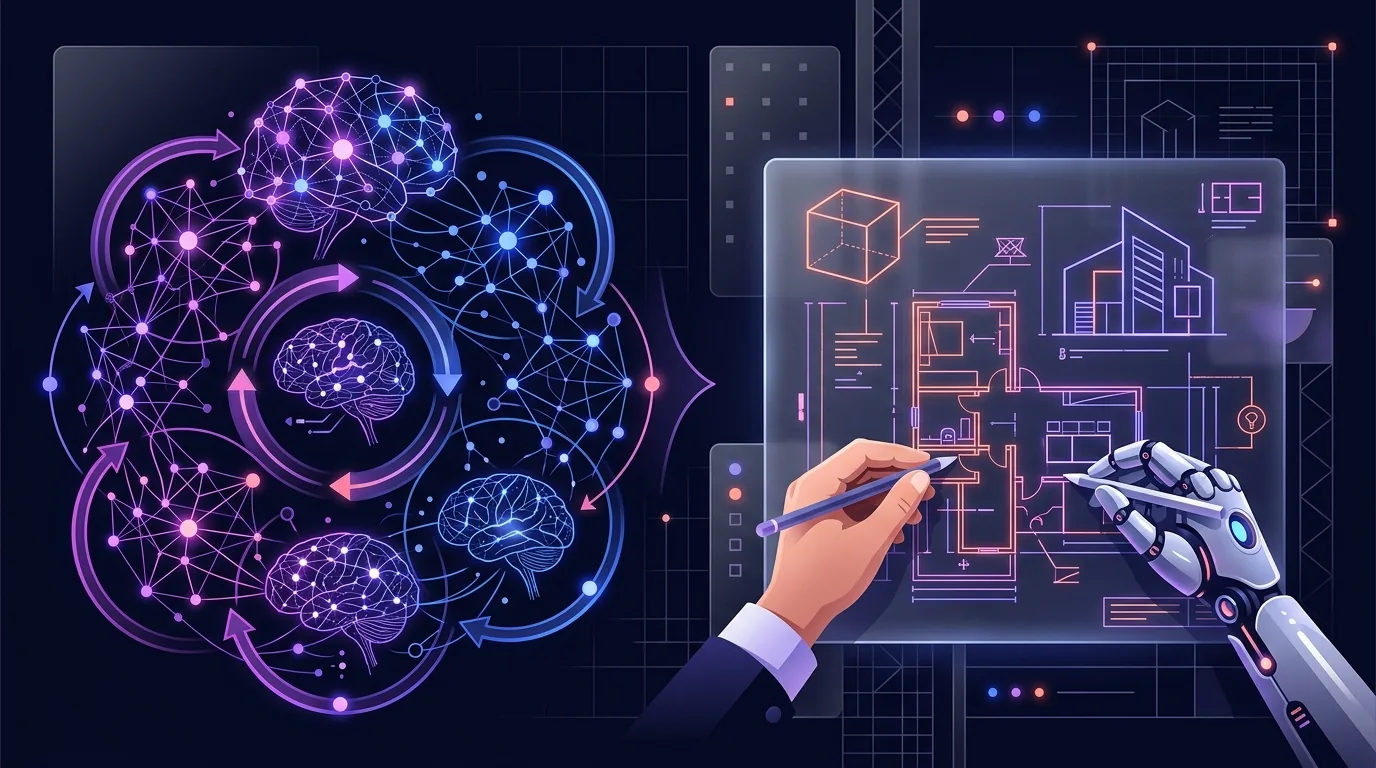
The era of the conversational chatbot has quietly closed.
If 2023 was the year of prompt engineering and 2024 was the dawn of multi-step retrieval, late 2026 is unmistakably the year of autonomous execution agents.
We have passed the point where developers ask a language model to explain an algorithm or generate a regex string. In the last two weeks alone, two watershed milestones demonstrated how profoundly the ground has shifted beneath our feet:
- Cognition's Devin reached a $1 billion annualized revenue run rate. What was once dismissed as a benchmark-cherry-picked demo has embedded itself across engineering teams at GE Aerospace, Rivian, and NVIDIA. Powered by proprietary SWE-2 models and multi-model dynamic orchestration, Devin autonomously migrates enterprise legacy stacks, spins up isolated Docker clusters, writes end-to-end integration suites, and resolves production pull requests over multi-hour background loops.
- xAI rolled out Grok 4.7 and the persistent Grok Bot agent ecosystem. Featuring a 500,000-token active context window and architectural primitives explicitly designed for "agent stamina," Grok Bot now executes long-horizon, autonomous knowledge workflows—from financial risk modeling via direct protocol integrations to autonomous bug remediation—with continuous self-verification and minimal human prompting.
Across Silicon Valley and global engineering departments, the verdict seems unanimous: software is moving from human-authored with AI assistance to AI-authored with human supervision.
Yet as these agents become exponentially more capable of doing the work for us, a quiet, alarming paradox is taking root in engineering teams and universities worldwide:
When AI agents can build any architecture in thirty minutes, how will the next generation of engineers learn how anything actually works?
1. The Execution Illusion: When Delegating Destroys Comprehension
Consider what happens today when a junior developer or a computer science student confronts a difficult architectural challenge—such as implementing a fault-tolerant distributed consensus cluster or configuring an asynchronous event-driven streaming pipeline.
Two years ago, they struggled through documentation, sketched state machines on scrap paper, traced failed socket connections in Wireshark, and suffered through bugs. The process was slow and painful, but it built something indispensable: a durable mental model.
Today, they assign the prompt to an autonomous agent like Devin or Grok Bot:
"Implement a 3-node Raft consensus cluster with leader election, log replication, and an HTTP client interface. Containerize with Docker Compose and ensure zero data loss on node failure."
Forty minutes later, the agent reports back:
- 14 files created.
- 2,800 lines of idiomatic, clean Go code.
- 9 passing unit test suites.
- A green pull request ready to merge.
It feels like magic. It feels like 100x productivity.
It is also an educational catastrophe.
The engineer glances at the diff, skims the PR description, and merges it. They have a working artifact, but zero neural retention. They do not understand why the leader election timeout was chosen, how split-brain scenarios are arbitrated under network partitions, or why a mutex deadlock was narrowly avoided in the log commit handler.
Cognitive psychologists call this the Illusion of Explanatory Depth: because the agent solved the problem so effortlessly, the human brain tricks itself into believing it understands the underlying solution. But the moment an unpredictable race condition brings down the production cluster at 3:00 AM, the human supervisor is completely helpless. They are maintaining a system whose foundational principles they never learned.
2. The Jevons Paradox of Code
In 1865, English economist William Stanley Jevons made a counter-intuitive observation: when technological progress increases the efficiency with which a resource is used, total consumption of that resource does not decline—it explodes.
We are witnessing the Jevons Paradox of Code.
When writing code cost human hours, teams kept codebases disciplined, lean, and carefully scrutinized. When autonomous agents make generating complex code virtually free, the volume of enterprise code expands exponentially.
- Microservices multiply.
- State machines become labyrinthine.
- Abstraction layers are stacked atop abstraction layers.
Yet while the volume of agent-generated code has grown by 1,000%, human working memory remains strictly capped at roughly four chunks of information (Miller-Cowan limit).
The gap between the complexity of systems deployed by autonomous agents and the capacity of human minds to comprehend them is widening into a dangerous chasm. We are building a high-tech civilization running on software that no single living human being understands end-to-end.
3. Execution Agents vs. Cognitive Agents: The Missing Half of AI
The fundamental mistake of the AI industry over the past two years has been treating all agentic intelligence as Execution Intelligence.
Look at the prevailing agent benchmarks (SWE-bench, GAIA, WebArena). Every benchmark measures one thing: Can the agent complete the task autonomously without human intervention?
- Goal: "Fix issue #402 in the repository."
- Loop:
Perceive→Shell Command→Read File→Edit File→Run Tests→Submit. - Metric: Execution success rate, cost per token, and time-to-PR.
These are Execution Agents. They are designed to replace human labor by hiding the problem-solving journey inside a black-box terminal loop.
Execution Agent (Devin, Grok Bot):
[User Prompt] ──────> [Black Box: 40 mins of background tool calls] ──────> [Finished PR / Code Dump]
                                                                                   │
                                                                   (Human learns nothing)
Execution agents are invaluable for enterprise maintenance, repetitive refactoring, and infrastructure migrations. But they are completely blind to human cognition.
What happens when a human doesn't want the problem swept away into a black box? What happens when a student, an architect, or an engineer needs to understand the architecture for themselves?
Here, an execution agent is worse than useless. Handing a student a completed 3,000-line codebase to teach them distributed systems is like handing someone a finished car to teach them thermodynamics.
The world does not just need Execution Agents. The world desperately needs Cognitive Agents.
Cognitive Agent (HeyPapin):
[Human Question] ──> [Shared 2D Whiteboard] <──> [Human Interruption / Drawing]
                             │
            (Dynamic Co-Construction of Mental Models)
A Cognitive Agent does not measure success by how quickly it can finish a task without you. It measures success by how deeply and rapidly it can transfer an architectural mental model into your brain.
4. Why the Shared 2D Whiteboard is the Only Cognitive Medium That Works
Why can't an AI agent simply "explain" what it built in text?
Because human working memory is inherently spatial.
When an AI drops a 2,000-word markdown explanation into a ChatGPT conversation, it forces the human brain through a punishing bottleneck: linear lexical serialization. To understand a distributed cluster, you have to read sentence 1, hold it in memory, read sentence 14, mentally reconcile it with sentence 4, and try to build an internal graph of the dataflow in your head.
Cognitive Load Theory shows that split-attention and transient text streams overwhelm working memory.
Human beings have always solved complex architectural problems using the oldest collaboration tool in history: the whiteboard.
On a 2D canvas:
- Relationships are topological, not verbal. You don't describe a database replica as "the secondary persistence layer receiving write-ahead logs from the primary leader node." You draw a cylinder, draw an arrow labeled
WAL, and point it to another cylinder. The brain grasps the spatial relation in 80 milliseconds. - The canvas is a shared memory buffer. It offloads working memory from your brain onto a physical 2D plane. You don't have to keep all parts of the system in your head simultaneously; the diagram holds state while you and the AI explore edge cases.
- True learning requires bidirectional co-authoring. Watching an AI draw a diagram (spectator mode) does not teach you anything—it triggers the Illusion of Competence. Real learning occurs when you interrupt:
"Wait, Papin, if the leader node dies here, why doesn't Node 3 immediately take over?"
And instead of streaming another paragraph of text, the agent reaches for the digital marker, puts a red X over the leader node, and sketches the election timeout countdown in real time.
5. Preserving the Human Architect in the Age of Autonomy
We are standing at a historic inflection point in the computing industry.
Within three to five years, autonomous agents like Devin and Grok Bot will likely write the majority of operational enterprise code. They will maintain databases, optimize query plans, and deploy microservices with stamina and speed that no human engineering team could match.
The question of our decade is not whether AI agents will automate coding. They will.
The real question is: Will there still be human architects who understand how the machines work?
If we only build tools that optimize for delegation, we will produce a generation of engineering "prompters"—operators who can instruct an agent to build a system, but who cannot evaluate its architectural trade-offs, explain its vulnerabilities, or rebuild it when it fails.
At HeyPapin, we believe human comprehension is not an obsolete luxury; it is the ultimate foundation of technological sovereignty. We don't want an AI that takes the marker out of your hand and tells you to look away while it finishes the job.
We want an AI that stands with you at the whiteboard—drawing with you, thinking with you, letting you interrupt, and sharpening your intuition until you look at the board and say:
"Oh. Now I finally see how it works."