
Meet HeyPapin — the AI whiteboard that thinks with you
Most AI tools answer in a wall of text. This one explains out loud while drawing the idea in front of you — and stops the moment you speak.
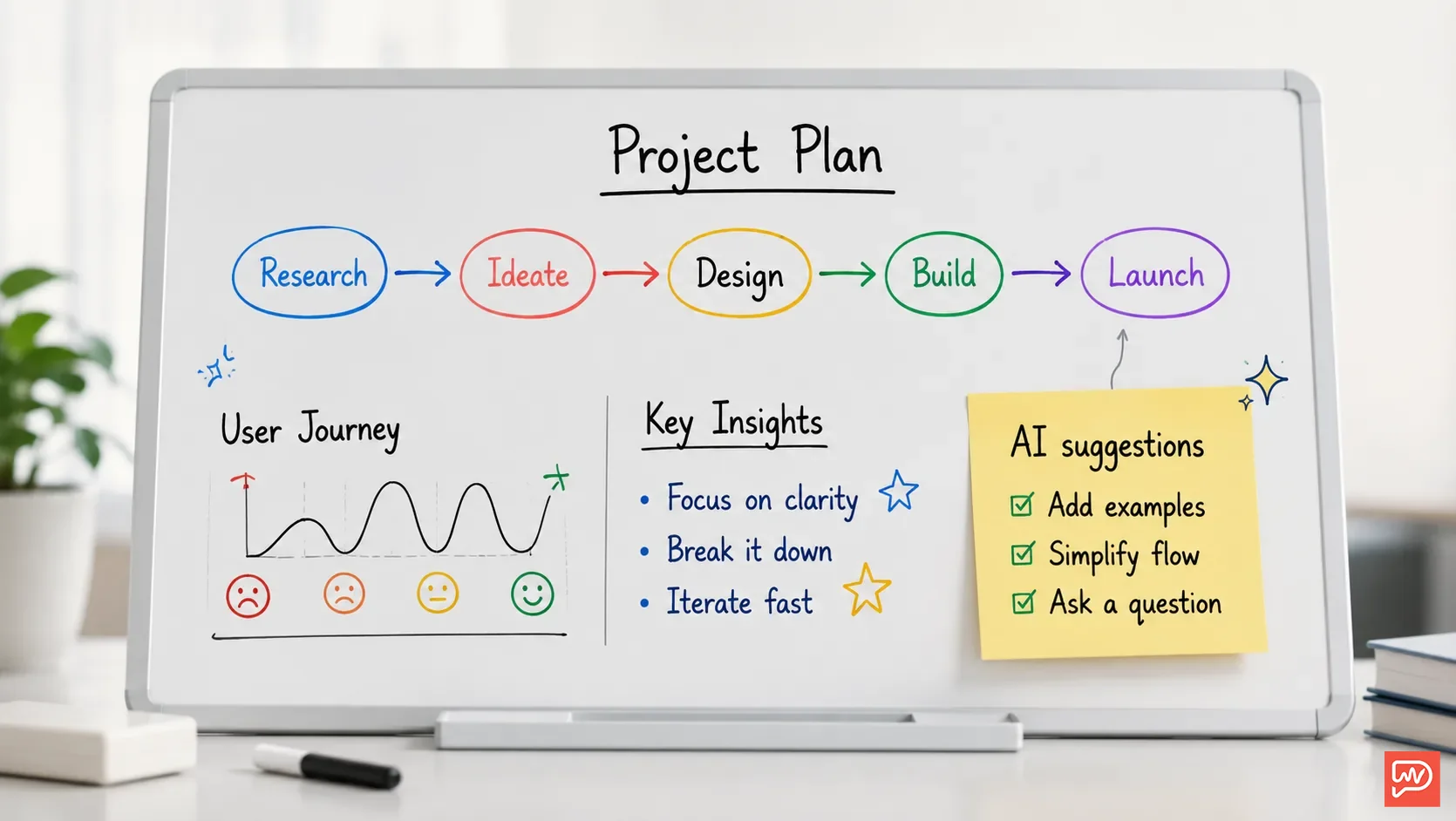
Most AI tools answer you in a wall of text. You read it, you nod, and ten minutes later you could not redraw the idea if someone asked. HeyPapin works differently: it explains out loud while drawing the thing on a whiteboard in front of you — and it stops the moment you speak.
That second part is the whole product, and it is the reason we built HeyPapin in the first place.
The problem with a perfect explanation
A chat window gives you a finished answer. Complete, well-structured, and delivered all at once. But understanding does not arrive all at once — it arrives in the middle, at the exact moment a step stops making sense.
In a chat window, however, that moment costs you the whole answer. You have to wait for it to finish, scroll back, quote the confusing part, and ask again. By the time you do, you have lost the thread of where you were.
By contrast, sitting with a real tutor, you just say "wait — why that step?" They stop mid-sentence, point at the thing on the board, and explain it right there. Nothing restarts. The diagram you were both looking at stays exactly where it is.
That is what HeyPapin does.
What actually happens
Name a topic — "how does gradient descent work" — and three things happen at once:
- It says the first sentence out loud
- A box appears on the board while it is still speaking that sentence
- The next beat continues from that box rather than starting a new thought
Interrupt at any point, by voice or by typing, and it stops. Then it answers by annotating the object already on the board — circling it, labelling it, connecting it to something — instead of wiping the board and drawing its own version again. Because the board is a living spatial graph, not a picture, every element retains its relationship.
That distinction sounds small and is not. A tutor that redraws is a tutor that did not listen.
Easier to watch than to describe:
The board belongs to both of you
You are not watching a video. You can draw on it.
Sketch a box, double-click it, give it a name — and HeyPapin adopts it. From that point on it is a real object on the board: it can be pointed at, annotated, and connected to whatever comes next. Your shape keeps your handwriting and your proportions — HeyPapin takes over its identity, never its appearance.
This matters when you are working something out. You draw what you think the structure is, and the tutor builds on your version instead of quietly replacing it with a tidier one (discover why drawing and spatial structure help retention).
Documents too
Upload a PDF — an assignment brief, a paper, a chapter — and HeyPapin reads it, then teaches from it. It maps the document onto the board and answers questions about it. The same rules apply: you can cut in, and it answers on what is already drawn.
What it is not
It is not a search engine, and it is not a homework machine. It does not know your syllabus, it does not remember what you understood last week, and it can be wrong about specifics — like every language model. We wrote a whole post comparing it with ChatGPT, Claude, and Gemini, including everything they do better, because pretending otherwise helps nobody.
What it is good at, on the other hand, is the thing that is genuinely hard to get elsewhere: someone patient who will explain something visually, at your pace, and does not mind being interrupted.
Try it
The board opens without an account — that is demo mode, a fixed script that shows how the interaction feels. A live session, where HeyPapin answers your own questions, needs a free sign-in with Google or a one-time email link. There is nothing to pay and nothing to configure; we ask you to sign in because live sessions cost us real money to run, and an endpoint that spends money and asks nothing gets drained within a week.
Boards you draw in a live session are saved to your account, so you can reopen them later — handwriting included.
#HeyPapin #AIWhiteboard #VisualLearning #VoiceAI #BargeIn #StudySmart #EdTech