
Why AI audio podcasts aren't enough: why real learning needs a whiteboard
AI podcasts sound impressive, but audio alone gives your working memory nothing to hold on to. Here is why a diagram that builds while someone talks — and lets you interrupt it — changes how we learn hard topics.
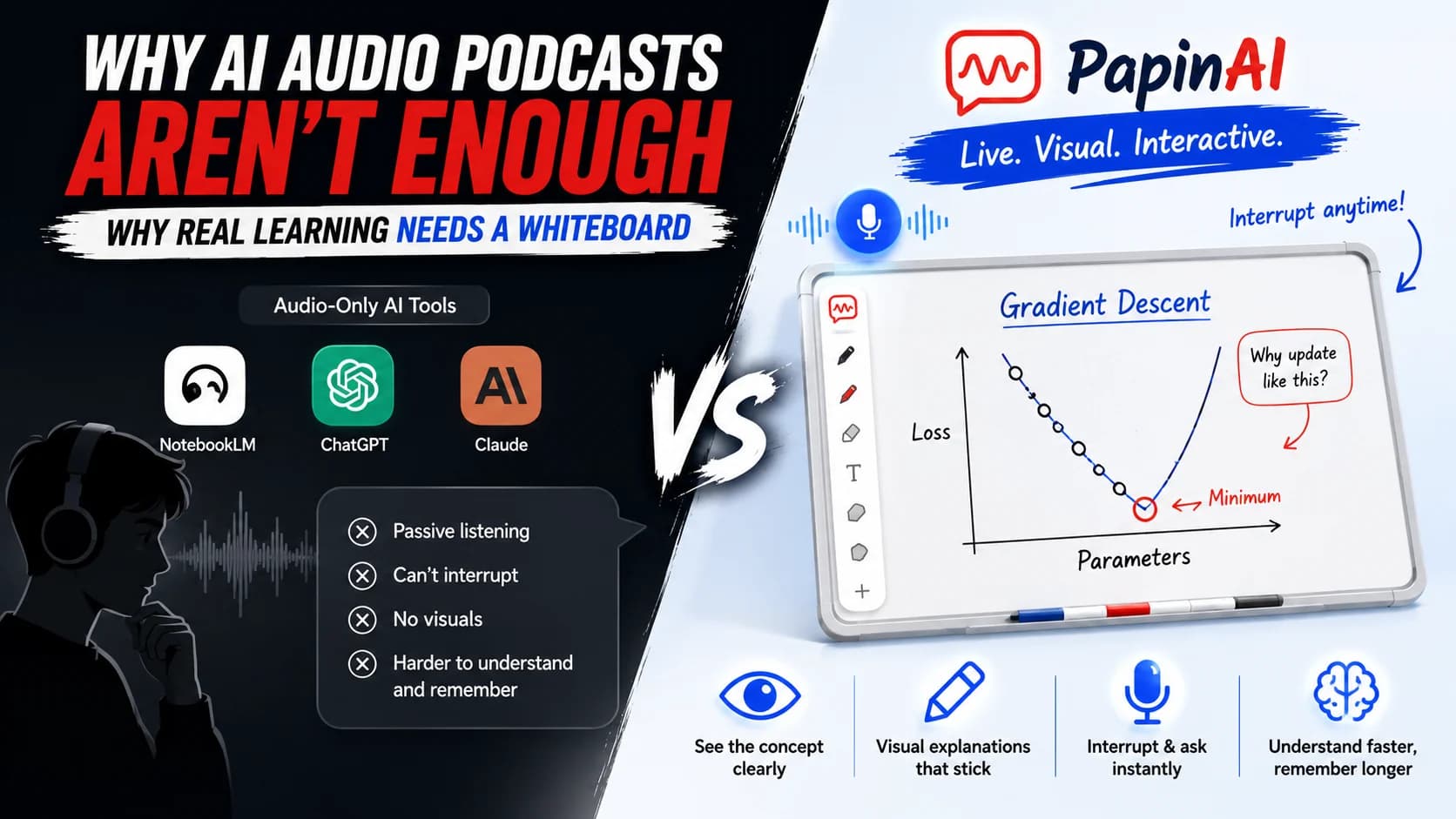
When AI-generated podcasts first appeared, they felt like magic. You feed in a thirty-page research paper, and within a minute two charismatic AI voices are bantering about transformer attention or fiscal policy.
It was entertaining, and it went everywhere. However, within a fortnight students and engineers had started reporting the same uncomfortable pattern.
You finish a ten-minute AI podcast. You feel like you learned something. Then you sit down to solve a problem and realise you cannot reconstruct a single relationship between the parts.
So why does that happen? And what does a whiteboard add that audio structurally cannot?
Fluent audio feels like understanding
Listening to an audio overview triggers what cognitive scientists call the illusion of competence. Because the hosts sound articulate and confident, your brain confuses familiarity with mastery. The ideas go down smoothly, so you assume you have them.
Passive audio stream (podcast)  ──► High engagement, nothing to point back at
Interactive visual whiteboard   ──► Spatial scaffolding + active recall
In reality, working memory is severely constrained. Since George Miller's classic 1956 paper, psychologists have put its capacity at roughly four to seven chunks at any one moment. Later estimates for genuinely unfamiliar material are lower still.
Now consider what a podcast asks of it:
"The encoder maps input tokens into continuous representations, which pass through multi-head self-attention before feedforward projection and residual layer normalisation..."
Your acoustic buffer overflows around the fifth word. Without a visual anchor on a screen, your brain simply discards the earlier terms to make room for the new ones.
Two channels carry more than one
The brain does not process the world through sound alone. Under Allan Paivio's dual coding theory (which we dive into in why drawing helps retention), it handles information through two separate channels:
- The verbal channel — spoken words, cadence, narrative.
- The non-verbal channel — spatial relationships, shapes, arrows, colour, layout.
When both channels carry the same idea at once, each gives the other a place to attach: the diagram holds the structure while the voice carries the exceptions. Furthermore, this is why a drawing that appears while someone talks does more than the same drawing shown afterwards.
[ Spoken voice: "Let's connect X to W" ]
                  │
                  ▼ (Synchronised in real time)
[ Canvas stroke: arrow drawn from box X to box W ]
Watching a diagram get built in real time gives you two things at once:
- The canvas becomes external working memory. You do not have to hold step one in your head, because you can glance at the left of the board while Papin explains step three on the right. Because the board is a living graph rather than a static image, every piece remains interactable.
- The geometry carries meaning. An arrow from top to bottom reads as hierarchy; a dashed line marks something conditional. Neither needed a sentence.
The flaw audio cannot fix: you cannot interrupt it
Think about the last difficult lecture you sat in, or an hour with a good supervisor.
When the professor writes a confusing equation at minute two, you do not sit quietly for the next eight while they finish. You raise your hand:
"Wait — why did you transpose that matrix?"
A human teacher stops mid-sentence, points the marker at the exact symbol, and clears it up. Everything else on the board stays where it was.
In a podcast or a pre-recorded video, none of that is available to you. The audio keeps going. By minute four you are lost, and the recording has no idea.
AI podcast / video:
[ Confused at 02:15 ] ──► Audio keeps playing ──► Attention drifts ──► Lost by minute four

HeyPapin whiteboard:
[ You speak at 02:15 ] ──► Voice halts mid-stroke ──► Annotation on the existing board ──► Lesson resumes
This is the behaviour we built the product around — instant interruption and shared visual focus — and it is the one thing on this page that no amount of better narration can substitute for.
Nothing ever asks you a question
There is a second reason podcasts fall short of deep technical teaching: they never test you. Passive listening asks nothing of you, and asking nothing is what makes it feel easy.
So we gave Papin a way to ask back. In the middle of building up a neural network or explaining database sharding, it can leave a dashed mystery card on the board:
"Now, when the cache misses, what component do we query next?"
The session waits. You say or type "the primary database replica", and the card is replaced by a solid green box wired into the diagram. That single exchange turns consumption into recall — and recall is the part that survives until the exam.
The right tool for the job
| Learning goal | AI audio podcast (NotebookLM) | HeyPapin whiteboard |
|---|---|---|
| Best used for | Commutes, casual overviews, entertainment | Hard STEM concepts, coding, maths, exam prep |
| Modality | Audio only | Spatial canvas + synchronised voice |
| Working memory load | Heavy — you must hold the spoken structure | Light — the board holds it for you |
| Interactivity | Play and pause | Interrupt mid-sentence, mid-stroke |
| Testing and recall | None | Socratic [ ? ] cards |
To be fair to the format: audio podcasts are genuinely wonderful for discovering that a topic exists, and for the twenty minutes of a commute when a screen is not an option. We listen to them too.
But when you need to understand how a system fits together, nothing has yet replaced a patient tutor at a whiteboard with a marker in hand — one you can stop.
You can try interrupting ours right now, without an account. Open the board and cut in while it draws.
#CognitiveLoad #DualCodingTheory #ActiveRecall #VoiceAI #InteractiveLearning #NotebookLM #EdTech