
The Illusion of Competence: Why Watching an AI Draw Doesn't Mean You Learned It
When an AI sketches a flawless architecture diagram before your eyes, your brain mistakes visual clarity for personal mastery. Cognitive science calls this the illusion of competence. Here is why spectator-mode AI harms deep learning, and what actually creates lasting neural retention on a whiteboard.
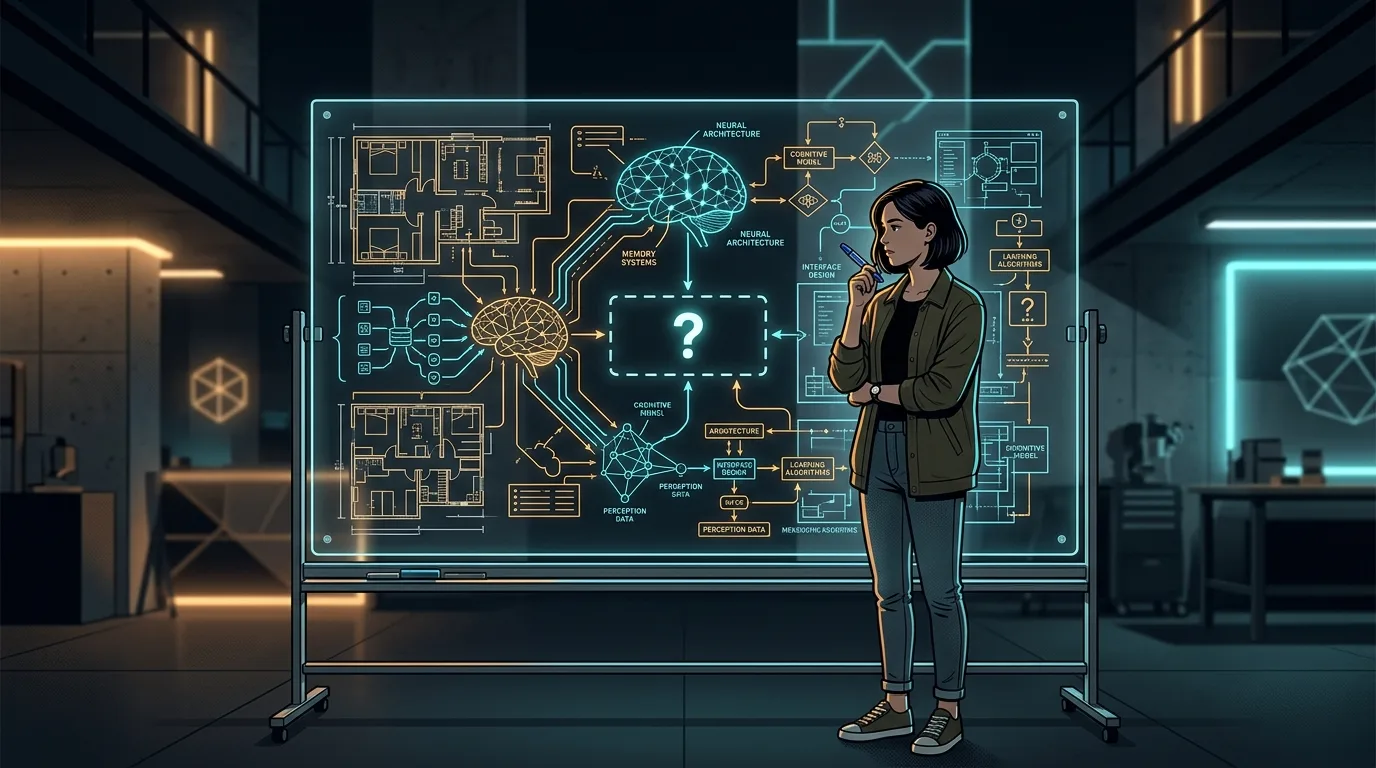
There is a distinct sensation that occurs when you watch a modern generative AI paint a complex architectural diagram onto an infinite whiteboard.
You type a prompt: "Explain how Kafka handles partition rebalancing."
Within three seconds, boxes materialize. Pastel nodes labeled Consumer Coordinator, Heartbeat Thread, and Zookeeper/KRaft Metadata snap into place with pixel-perfect alignment. Curved arrows glide smoothly between nodes, labeled with protocol messages. It feels instantaneous, mesmerizing, and authoritative.
As you watch the diagram assemble itself, your internal voice says: "Ah, yes. I get it now. That makes total sense."
You feel competent. You close the tab.
Then, forty-eight hours later, you sit across from a lead systems architect in a technical interview or stand before an outage whiteboard at 2:00 AM. Someone hands you a dry-erase marker and asks: "Walk me through partition reassignment when a consumer drops out."
You freeze. The confidence you felt two days ago has vanished. You remember that there were four boxes, and you vaguely recall an arrow with a timer, but you cannot draw which service initiates the join group request, or why the coordinator triggers a sync phase.
You didn't forget the material.
You never actually learned it in the first place.
What you experienced was one of the most well-documented cognitive traps in educational psychology: the illusion of competence. And modern autonomous AI whiteboard generators are engineering it at scale.
1. The Fluency Heuristic: When Readability Masquerades as Mastery
In cognitive science, the fluency heuristic describes the brain's instinctive tendency to equate ease of processing with depth of understanding.
When an explanation or visual artifact is aesthetically balanced, logically sequenced, and easily readable, your visual cortex processes the information with near-zero friction. Cognitive psychologists Leonid Rozenblit and Frank Keil termed this phenomenon the Illusion of Explanatory Depth (IOED): people routinely overestimate their grasp of complex causal systems until they are forced to produce an explanation from scratch without looking.
+-------------------------------------------------------------------------+
|                  THE PASSIVE AI SPECTATOR PARADOX                       |
|                                                                         |
|  [ Prompt ] ──► [ Autonomous AI ] ──► [ Finished Canvas Diagram ]       |
|                         │                                               |
|                         ▼                                               |
|               High Visual Fluency                                       |
|               Low Germane Cognitive Effort                              |
|                         │                                               |
|                         ▼                                               |
|             "Illusion of Competence"                                    |
|          (Feels learned in the moment;                                  |
|           evaporates under recall testing)                              |
+-------------------------------------------------------------------------+
When you watch an AI autonomously draw a system diagram, the AI is doing 100% of the cognitive work:
- It retrieves the entities from memory.
- It evaluates spatial boundaries and hierarchies.
- It resolves trade-offs between competing abstractions.
- It maps physical causal dependencies with arrows.
By the time your eyes land on the canvas, the struggle has already been solved. You are not a learner wrestling with a mental model; you are a spectator admiring a finished architectural blueprint.
Because you experienced no friction while consuming the answer, your brain registers the concept as "understood" and moves on without writing a single permanent trace to long-term memory.
2. The Working Memory Bypass
Why doesn't watching a diagram create lasting memories? The answer lies in how human memory consolidates.
In John Sweller’s Cognitive Load Theory, mental effort is categorized into three types:
- Intrinsic load: The inherent difficulty of the topic itself (e.g., distributed consensus algorithms).
- Extraneous load: Friction introduced by poor explanations, messy UI, or confusing jargon.
- Germane load: The active, effortful processing dedicated to organizing information, testing hypotheses, and integrating new concepts into existing schemas.
Germane load is where learning lives. Without germane effort, neural synapses do not undergo long-term potentiation.
When you passively watch an AI tool auto-generate a diagram, extraneous load is certainly low—the canvas is slick and clean. But germane load is zero. The AI bypasses your working memory entirely.
To prove this, researchers Henry Roediger and Jeffrey Karpicke conducted landmark studies on the Testing Effect and Generative Retrieval. Students who spent study sessions passively reviewing polished summary notes scored dramatically lower on delayed recall tests than students who were forced to retrieve answers, sketch diagrams from memory, or fill in missing blanks.
Simply put: Memory is the residue of thought. If the AI did all the thinking to produce the diagram, the memory belongs to the AI, not to you.
3. Desirable Difficulties: Why Friction is Not a Bug
In modern product design, friction is considered the ultimate sin. Every startup aims for one-click workflows, zero-latency generations, and instant gratification.
In educational technology, however, eliminating all friction destroys the learning process.
UCLA psychologist Robert Bjork introduced the concept of Desirable Difficulties: learning conditions that induce cognitive struggle, challenge, and slower initial performance, but lead to vastly superior long-term retention and flexible transfer.
When you struggle to figure out which component belongs between a message broker and a search cluster, that momentary pause—the brow-furrowing confusion, the mental simulation of data flow—is not wasted time. That hesitation is your brain actively testing and reinforcing synaptic connections.
When an AI tutor instantly answers every question before you even formulate a hypothesis, it deprives you of the very difficulty required to make knowledge permanent.
+-------------------------------------------------------------------------+
|                  THE ACTIVE KINETIC LEARNING CYCLE                      |
|                                                                         |
|  [ Prompt ] ──► [ AI Explains First Beat ] ──► [ Draws Concept Anchor ] |
|                                                       │                 |
|                                                       ▼                 |
|                                            [ Inserts Blank Slot: ? ]    |
|                                                       │                 |
|                                                       ▼                 |
|  [ Next Beat Builds On Your Work ] ◄── [ Student Fills Slot / Draws ]   |
|  (Bilateral Co-Creation: The board is a shared cognitive playground)    |
+-------------------------------------------------------------------------+
4. Moving Beyond Spectator AI: How HeyPapin Breaks the Illusion
When we built HeyPapin, our objective was never to build an MCP diagram printer. We didn't want to make another tool where a student sits back with their hands off the keyboard while a machine puts on a visual show.
Real tutoring is bilateral. A real tutor at a physical whiteboard doesn't draw an entire textbook chapter while you sit silently. They sketch a single box. They talk. Then they hand you the marker and say: "What connects to this?"
To turn the whiteboard from a spectator stage into a kinetic cognitive partner, we architected three core mechanisms:
A. Interactive Blank Slots (kind: "blank")
Instead of drawing a finished diagram, HeyPapin frequently pauses mid-lesson and renders dashed, pulsing quiz slots marked [ ? ].
Before the tutor moves to the next architectural tier, it prompts you to deduce or choose the missing concept. If you guess wrong or get stuck, it doesn't give away the punchline—it points back to the prerequisite node on the canvas and gives you a Socratic hint.
You cannot passively skim. You must retrieve and apply.
B. Shape Adoption & Co-Creation
When you draw a rectangle or an arrow on HeyPapin's canvas, it is not an ignored overlay.
Through our spatial adoption engine (detailed in The Part That's Ready: What Sets Us Apart), the AI inspects your handwritten shapes, takes over their semantic identity, and builds the rest of the lesson directly from what you drew.
Your sketch keeps your proportions and handwriting, but the AI connects its next concept directly to your box. You are an author of the diagram, not an audience member.
C. The Living Spatial Graph
Because the board is not a picture, every element has an immutable identity and coordinate grid.
When you interrupt the tutor mid-explanation, it doesn't wipe the screen or regenerate a new picture from scratch. It halts, retains the existing mental state, circles the exact box you questioned, and explains the anomaly right there before resuming.
5. The Question Every Learner Must Ask
The next time an AI tool draws a breathtaking diagram for you in two seconds, don't just admire the artwork.
Close your laptop. Grab a blank sheet of paper. Try to redraw that diagram from memory and explain every arrow out loud.
If you can't, you didn't learn it. You just enjoyed the show.
Generative AI has given us tools of extraordinary power. But the goal of education has never been to build machines that think for us—it is to build tools that challenge us to think more deeply ourselves.
That is why we don't just generate diagrams at HeyPapin. We invite you to pick up the marker.
Explore related deep-dives on visual learning architecture: